The vision

What invisible links connect the living world?

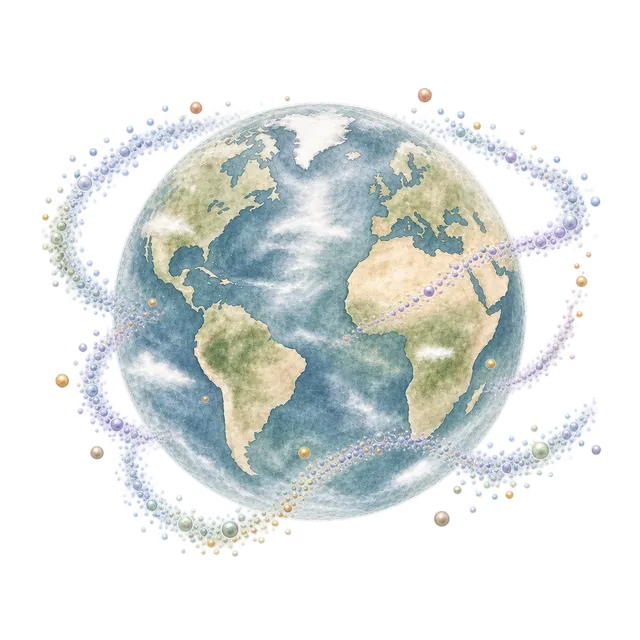
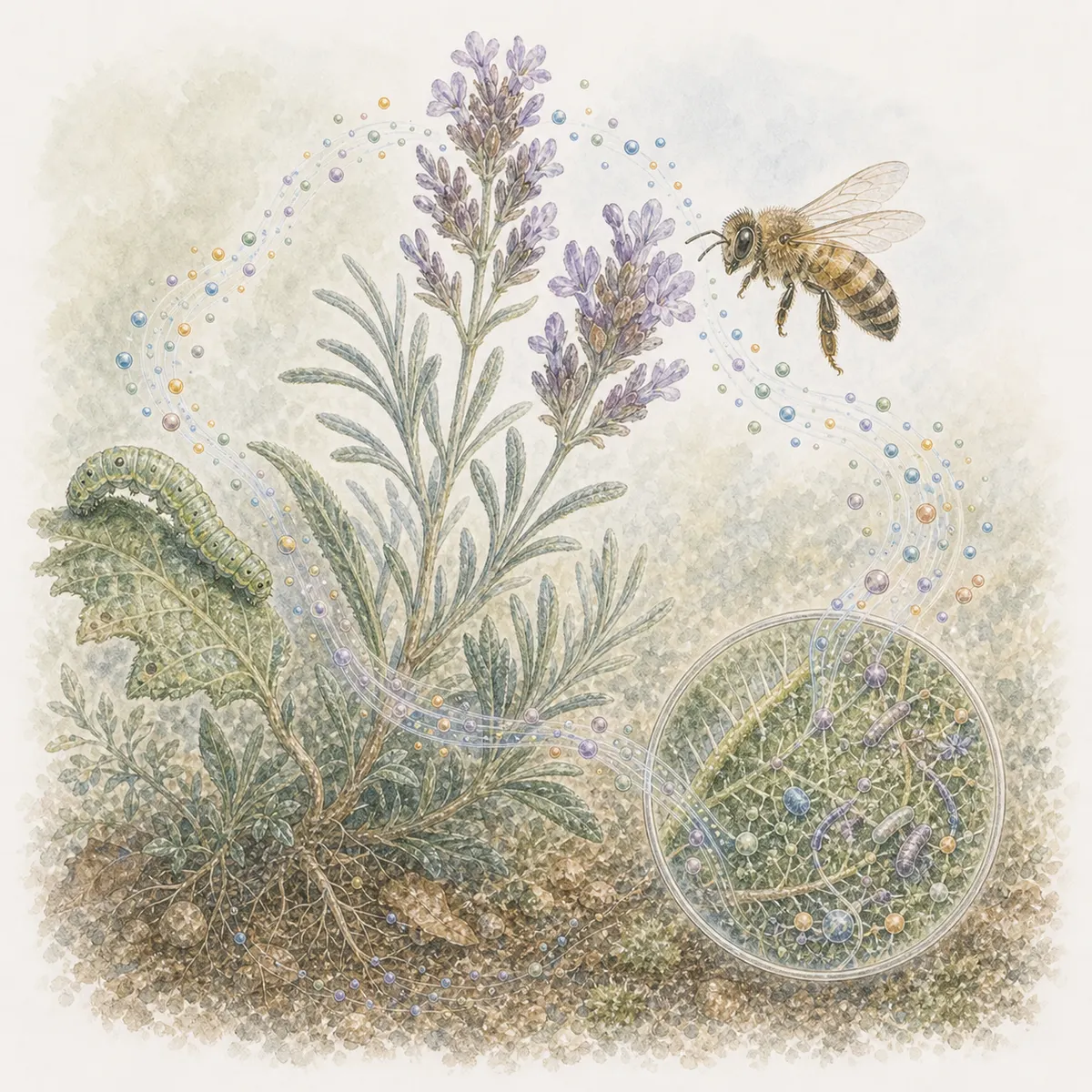
A molecule leaves a plant, an animal, a microorganism or a body. It circulates through an environment. Another organism may encounter it, transform it or respond to it. The map makes it possible to follow these relationships without losing sight of the whole.

Its lines make visible what we often separate: environments, organisms, the body, experience and planetary balances.

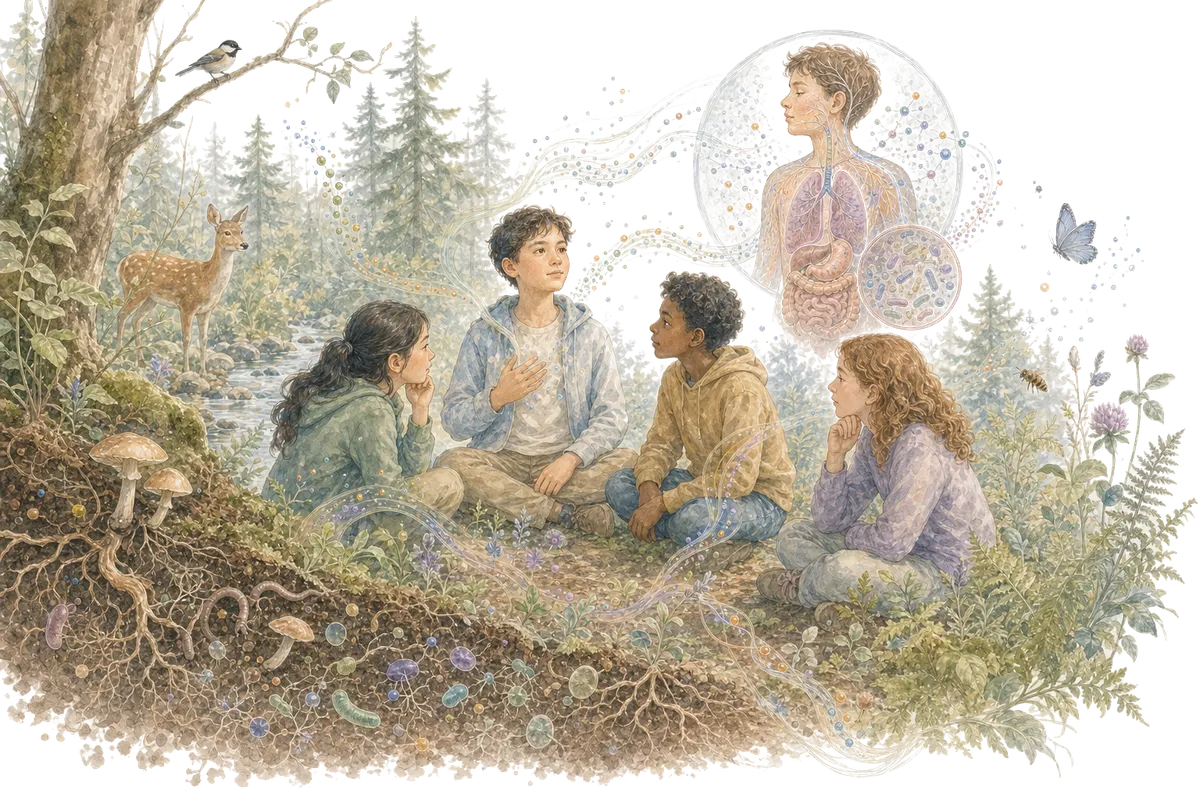
Young people in a forest, connected to the living world, with a close-up of the body and the microbiome
Changing scale makes it possible to follow a relationship without losing sight of the whole.

The map of interdependencies

Choose a door. The network remains whole.

Start with the door that intrigues you. The invisible lines show how it joins the other dimensions. The map remains whole, even when we observe only part of it.

Sensosphere The relational field of the living world Connecting the scales of life.
Illustration of the selected door

Selected door

The network of life

Plants, animals, bacteria, fungi, viruses and other organisms live in shared environments. Their relationships unfold within a single kingdom and across several kingdoms, either directly or through the environment.

Examples: plant–plant, flower–pollinator, bacterium–fungus, root–microbiomes.

The scientific foundation

Three levels to distinguish without separating.

A forest, a cell and a memory belong to the same world, but they are not explained in the same way. Sensosphere respects their differences while showing their interdependencies.

The network of life

Plants, animals, fungi and microorganisms live in shared environments. They depend on air, water and soil, and on one another. Molecules circulate through this network.

The body in interaction

Our body can be seen as an inner ecosystem interacting with its environment. The skin and mucous membranes form interfaces. The nervous, hormonal and immune systems, metabolism and microbiomes influence one another and contribute to the organism’s responses. Psychoneuroimmunoendocrinology — PNIE — studies some of these interactions. Volatile compounds and their receptors are one of the threads through which they can be explored.

The lived and relational world

We do not experience a molecule or a situation the way an instrument measures it. Sensations, emotions, memory, learning, beliefs, patterns, personal history, relationships and context contribute to the meaning that experience takes on. This lived experience can in turn guide our attention, our responses and the way we act.

Principle

The three levels are interdependent. They form neither compartments, nor a hierarchy, nor a single causal chain. Each influences the others, and none is sufficient on its own to explain the whole.

The founding Exploration mainly makes the network of life perceptible — level 1 — while opening up its links with the body and experience. The deepening with essential oils then makes it possible to observe, on a more personal level, the relationships between the body, mental life and emotional life — levels 2 and 3.
Perception as the hinge

Perceiving is not recording reality.

The nervous system integrates sensory information, the body’s internal signals, memory, learning and relational context. What we notice and how we respond also depend on our physiological state at the time.

These filters are not flaws: they make experience possible. Recognising that another person may experience the same situation differently allows part of our judgement to be replaced by a more fitting curiosity, while keeping our own boundaries and discernment.

Why this name?

The senses, meaning and direction.

Sensosphere brings together the senses through which we encounter the world, the meaning we give to what we experience, the direction we choose and the sphere of relationships to which we belong. At the heart of the word, SOS can also be read symbolically as Save Our Souls: a reminder to take care of what makes relationship possible, within us, between us and around us.

This reading is a symbol of the project, not the historical origin of the word nor scientific proof.

Our place

Each person is at the centre of their experience, but not at the centre of the living world.

The map connects knowledge, experience and responsibility without claiming to reduce the living world to a single model.